Your company spends half a million dollars on an AI solution. Six months later, senior leaders ask, “Where’s the return on AI?” The technology works. Teams are using it. But when pressed for hard numbers like cost savings, revenue lift, or productivity gains, the answers are vague.
Most enterprises are no longer asking whether they should invest in AI. The real question is far more uncomfortable. Is AI actually delivering measurable business value?
Across industries, AI budgets are growing faster than ever, yet boardrooms continue to struggle with one fundamental issue: proving the ROI of AI. While pilots show promise and demos look impressive, translating those efforts into clear financial outcomes remains difficult. This gap between expectation and reality has given rise to a more focused way of thinking about AI investments: ROAI.
According to a 2025 survey of over 3,400 senior leaders of global enterprises, a whopping 88% of those diving deep into agentic AI think autonomous systems that handle tasks with minimal hand-holding are already reaping positive ROI on at least one use case.
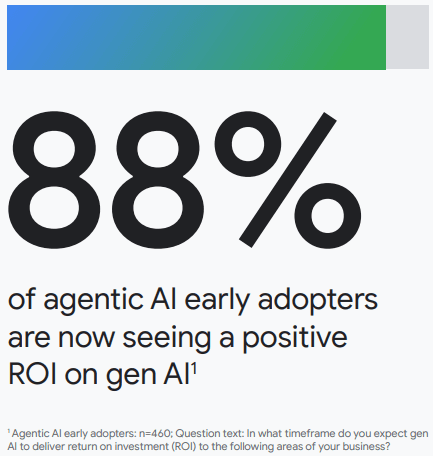
Yet, for the broader crowd, that figure dips to 74%.
Why the gap? It boils down to understanding the ROI of AI not as a buzzword, but as a strategic lifeline.
In today's cutthroat market, where AI promises everything from doubled productivity to slashed customer service times, getting the Return on AI right could mean the difference between leading the pack and trailing behind.
This blog explores what ROAI really means, how enterprises can calculate the ROI in AI initiatives, the key metrics that matter, and the challenges that often derail even the most well-funded AI programs.
Demystifying ROAI: What Exactly Is the ROI of AI?
ROAI, or Return on AI, is shorthand for the bang you get for your AI buck. More formally, the ROI of AI measures the net benefits like financial and otherwise, against the costs of deploying and maintaining AI systems. It's not some abstract metric; it's the scorecard that tells you if your chatbots are just cute conversation starters or revenue rocket fuel.
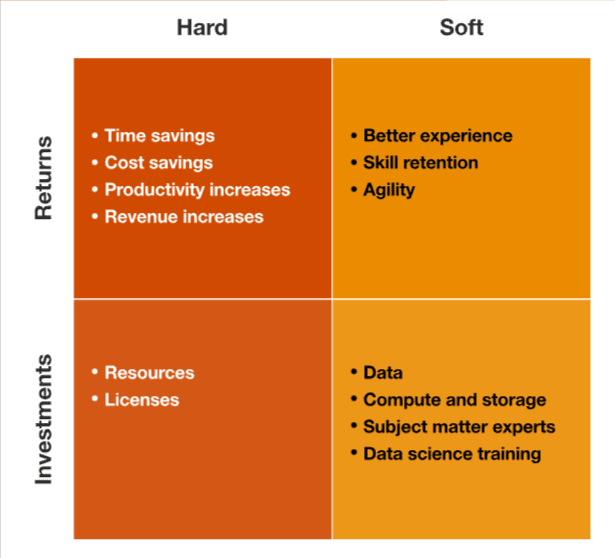
At its core, the ROI of AI splits into two camps: hard returns and soft ones.
Hard ROI in AI covers the cold, hard cash stuff, like cost savings from automating routine tasks or revenue bumps from personalized marketing campaigns. Take PayPal's AI-driven fraud detection: it blocked approximately $500 million in fraud per quarter amid skyrocketing transaction volumes.
Soft ROI in AI, on the other hand, captures the fuzzier wins, such as happier employees freed from drudgery or customers sticking around longer. These might not show up in quarterly earnings right away, but they compound like interest in a high-yield account.
Source - https://www.pwc.com/us/en/tech-effect/ai-analytics/artificial-intelligence-roi.html
Why does this matter now? AI has evolved from clunky algorithms to agentic powerhouses systems that don't just analyze data but act on it, like drafting emails or resolving tickets solo.
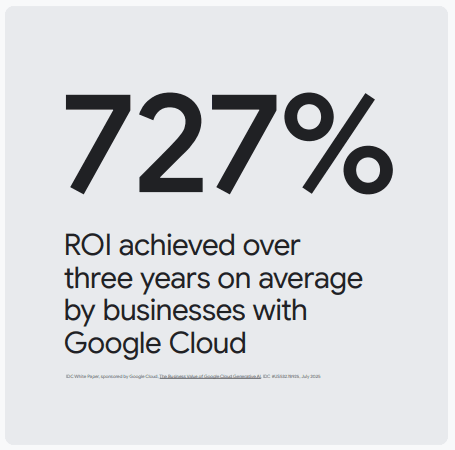
A Google Cloud study pegs the average three-year ROI of AI at 727% for adopters using their gen AI suite, with $1.4 million in extra net revenue per organization. That's the ROI of AI in action: not a gamble, but a calculated edge.
Yet, as we'll see, nailing ROAI requires more than plugging numbers into a spreadsheet. It demands alignment with your business heartbeat, from C-suite buy-in to frontline execution.
In essence, ROAI isn't a one-size-fits-all formula. For a retailer, it might mean 37% of execs reporting ROI from customer experience tweaks via AI agents. For a manufacturer, it's 56% seeing marketing efficiencies. The common thread? The ROI of AI thrives when it's tied to real problems, not hypothetical hype.
The Power Players: Key Drivers Fueling the ROI of AI
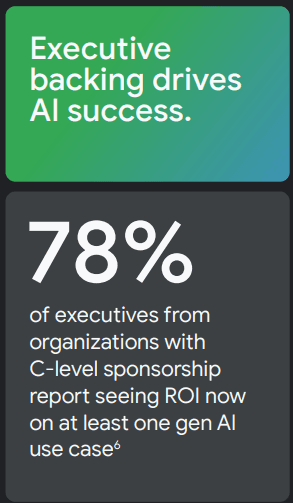
What lights a fire under the ROI of AI? It's a mix of internal grit and external tailwinds. First up: executive sponsorship. Organizations with full C-level alignment boast 78% seeing ROAI on at least one gen AI initiative, up from 69% last year. These leaders don't just nod along; they weave AI into the company DNA, allocating 39% of IT budgets to it for early adopters. Contrast that with laggards, and the ROI in AI gap yawns wide.
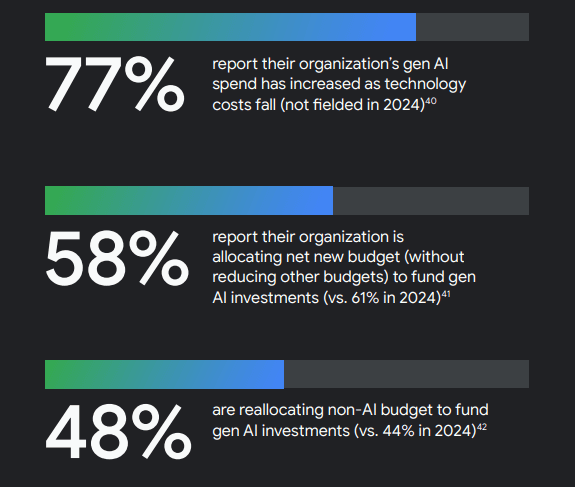
Budget smarts come next. As AI costs tumble, think cheaper cloud compute, 77% of firms are ramping up spend, with 58% carving out fresh funds. Smart ones redirect from legacy tech, focusing on agentic AI that handles 50% or more of future AI dollars.
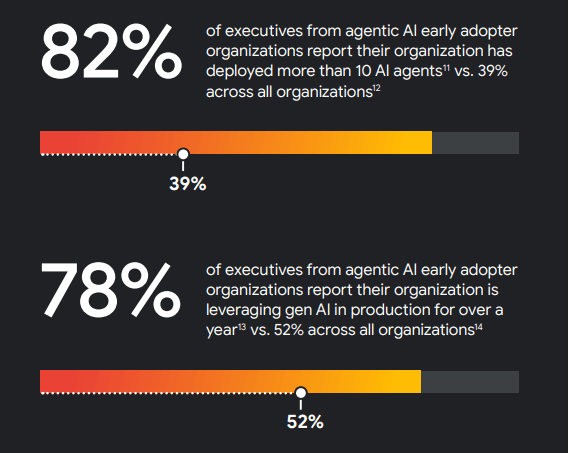
This isn't splurging; it's investing in multipliers. Early adopters, who've had gen AI in production for over a year, report 82% maturity, translating to doubled productivity for 39% of teams.
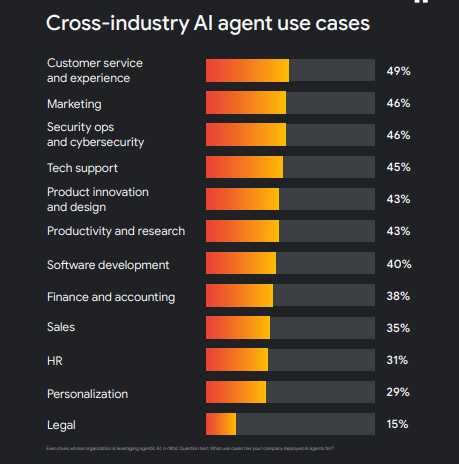
Use case selection is another driver. The ROI of AI skyrockets when you target high-impact zones like customer service (49% adoption) or security (46%).
A hospital deploying AI for radiology workflows? They clocked a 451% five-year ROI, factoring in time savings and extra diagnoses. It's about picking low-hanging fruit first, quick wins that fund bolder plays.
Data Quality and Accessibility fundamentally determines AI effectiveness. Models trained on poor data deliver poor results, regardless of algorithm sophistication. Organizations that invest in data infrastructure, governance, and quality management before deploying AI see better outcomes than those rushing to implementation without this foundation.
Talent and culture seal the deal. Upskilling tops investment lists at 40%, because AI shines when humans steer it. Companies fostering AI literacy see faster adoption, turning skeptics into champions. Add seamless integration with existing tools, and you've got a flywheel: ROI in AI begets more ROI on AI, as proven by firms like Wayfair, where AI agents speed up everything from inventory to ideation.
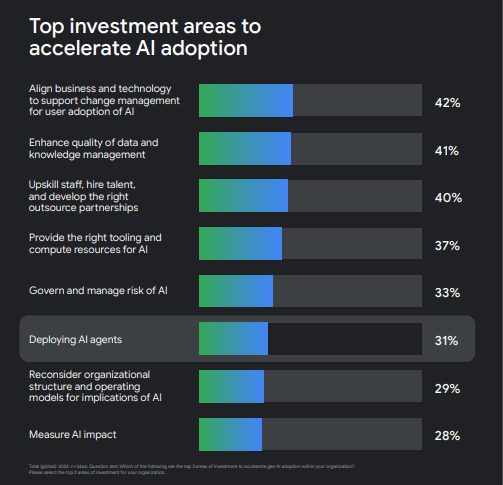
In short, the drivers of ROAI boil down to strategy, spend, and people. Ignore them, and your return on AI stays flat. Embrace them, and watch the numbers climb.
A Practical Framework to Measure and Improve ROAI
Based on industry best practices and real-world case studies, here’s a step-by-step framework to turn ROAI from a theoretical concept into an operational discipline:
Step 1: Start with a Business Hypothesis
Ask: “What specific problem are we solving?” Avoid “AI for AI’s sake.” Frame your initiative around outcomes: “Reduce customer onboarding time by 30%” or “Cut false positives in underwriting by 25%.”
Step 2: Establish a Baseline
Measure current performance rigorously. If your sales cycle averages 45 days today, that’s your benchmark. Without this, you can’t prove AI moved the needle.
Step 3: Map All Costs - Visible and Hidden
Include:
Licensing and cloud infrastructure
Data engineering and cleaning
Talent (data scientists, ML engineers, change champions)
Integration with legacy systems
Ongoing maintenance and retraining
Google Cloud notes that hidden costs can inflate total investment by 30–50% if not planned for upfront.
Step 4: Define Dual Metrics
Select 2–3 Trending ROI indicators and 2–3 Realized ROI indicators. Track both in parallel.
Trending ROI (Leading Indicators)
These are early, enabling metrics that signal momentum:
Reduction in average handling time for support tickets
Increase in employee utilization of AI tools
Faster cycle times in product development or hiring
Improved customer satisfaction (CSAT) or Net Promoter Score (NPS)
While not directly financial, these soft ROI signals validate that your AI is being adopted and delivering experiential value, critical prerequisites for long-term gains.
Realized ROI (Lagging Indicators)
These are the hard numbers executives care about:
Direct cost reduction (e.g., 20% fewer FTEs needed in a process)
Revenue uplift from personalized recommendations
Risk mitigation (e.g., fewer compliance fines or fraud losses)
Operational efficiency (e.g., 15% less waste in manufacturing)
Step 5: Build a Governance Loop
Create an AI ROI council that reviews performance quarterly. Compare forecasted vs. actual ROAI. Use insights to kill low-performing pilots and double down on winners.
Step 6: Calculate with Realistic Time Horizons
Most AI projects take 12–24 months to deliver full value. Use Net Present Value (NPV) models that account for the time value of money and risk-adjusted returns.
For example, a mid-sized firm deploying an AI recruiting tool saved 30% in hiring costs, that’s almost a 100% ROAI. But those savings only materialized after six months of tuning and adoption.
Key Metrics for Measuring ROI in AI
Measuring ROAI requires a balanced set of quantitative and qualitative metrics. Relying on financial numbers alone rarely tells the full story.
Financial Metrics
These metrics form the backbone of ROI of AI calculations:
Cost reduction from automation
Revenue uplift driven by AI recommendations
Reduction in rework or error-related costs
Return compared to total AI implementation and maintenance costs
Operational Metrics
Operational improvements often signal future financial gains:
Cycle time reduction
Accuracy and precision improvements
Throughput increase
Resource utilization efficiency
Customer-Centric Metrics
AI-driven customer experiences can significantly impact long-term ROAI:
Net Promoter Score changes
Customer retention rates
First response and resolution time
Personalization effectiveness
Strategic Metrics
Some ROI in AI outcomes are strategic rather than immediate:
Speed of decision-making
Ability to launch new AI-enabled offerings
Competitive differentiation
Risk mitigation
Together, these metrics provide a more realistic view of Return on AI.
Common Pitfalls That Skew ROAI Calculations
Even well-intentioned teams make critical errors when measuring ROAI:
1. Ignoring the Cost of Errors
AI models aren’t perfect. A misclassified customer complaint or a false-positive fraud alert carries real financial and reputational costs. Always factor in error rates when estimating benefits.
2. Measuring Too Early or Too Late
Calculating ROI in AI just three months post-launch misses the ramp-up period. Waiting two years ignores early warning signs. The sweet spot? Quarterly reviews that track both adoption and outcomes.
3. Treating AI Projects in Isolation
AI value compounds across use cases. A data pipeline built for marketing personalization might later support risk modeling. Evaluate your Return on AI at the portfolio level, not just per project.
4. Overlooking Change Management
Even the smartest AI fails if users resist it. One hospital implementing AI radiology tools saw ROAI plummet until they redesigned workflows to embed AI seamlessly into clinician routines.
The Role of AI Readiness in Driving ROAI
Here’s an uncomfortable truth: no amount of sophisticated modeling will rescue an organization that isn’t ready for AI.
Many companies jump straight to solutioning without assessing foundational elements like data maturity, process stability, or leadership alignment. The result? Poor ROAI, wasted budgets, and eroded stakeholder trust.
That’s why we developed our AI Readiness Assessment Tool, a practical, 10-minute diagnostic that evaluates your organization across five critical dimensions:
Data foundation
Technology infrastructure
AI & analytics capability
Culture & people
Strategic Alignment
The tool doesn’t just tell you if you’re AI-ready, it identifies specific gaps that, if unaddressed, will cap your Return on AI. For example, one retail client scored high on strategy but low on data governance. After investing in data cleanup and metadata tagging, their pilot AI forecasting model improved accuracy, directly boosting ROAI.
This assessment isn’t a theoretical exercise. It’s a frontline defense against the most common causes of AI underperformance.
Conclusion: ROAI is a Discipline, Not a Dashboard
Measuring the ROI of AI isn’t a one-time math problem. It’s a strategic discipline that blends financial rigor, change leadership, and continuous learning. Companies that treat Return on AI as a dynamic, multi-dimensional metric, consistently outperform peers who chase quick wins or tech hype.
If you’re serious about maximizing ROAI, start by asking: Are we truly ready?
Our AI Readiness Assessment Tool gives you a clear, actionable snapshot of your organization’s preparedness across data, talent, infrastructure, and strategy. In under 10 minutes, you’ll uncover the hidden bottlenecks that could sabotage your AI ROI and the levers you can pull to accelerate value.
Because in the end, the goal isn’t just to deploy AI. It’s to ensure every dollar invested delivers measurable, sustainable, and strategic return.
Ready to turn your AI investments into undeniable business value? Take the assessment today and start building your road map to real ROAI.