Everyone is talking about AI. Few are measuring its worth.
It is Dubai's Smart City initiative driving AI adoption across sectors. While AI is reshaping the way the UAE does business, CEOs are asking the hard question: "Where is the ROI?" Too often, investments are lost in fragmented systems and unclear goals. With the UAE AI market projected to reach $X billion by 2025, the cost of inefficiency is rising and businesses can no longer afford to fly blind.
We believe the metric that matters most is ROAI:Return on AI Investment.
At Sedin, we bridge the gap between technology and profit. Our unique framework assesses your readiness, unifies your data, and deploys intelligent automation where it matters most. We help you move from hype to a measurable 3-5x ROI.
If you’re ready to make AI work for your bottom line, read on to explore the key growth drivers, industry spotlights, and the implementation roadmap used by the region's top performers.
Understanding ROAI: Beyond Traditional ROI
Before diving into how AI functions, it is crucial to understand how its value is measured. Return on AI (ROAI) is a specialized metric that measures the tangible business value generated per dirham invested in AI solutions.
While traditional ROI focuses primarily on immediate cost reductions, ROAI takes a broader view of organizational impact. It accounts for dynamic factors that standard automation metrics often overlook:
Velocity Gains: The value derived from faster decision-making cycles.
Quality Improvements: Cost reductions from lower error rates combined with revenue upside from enhanced customer experiences.
Scalability: The ability to achieve revenue growth without a proportional increase in operational costs.
Competitive Advantage: The long-term value of market positioning and innovation leadership.
To quantify this, the standard formula for calculating ROAI is:
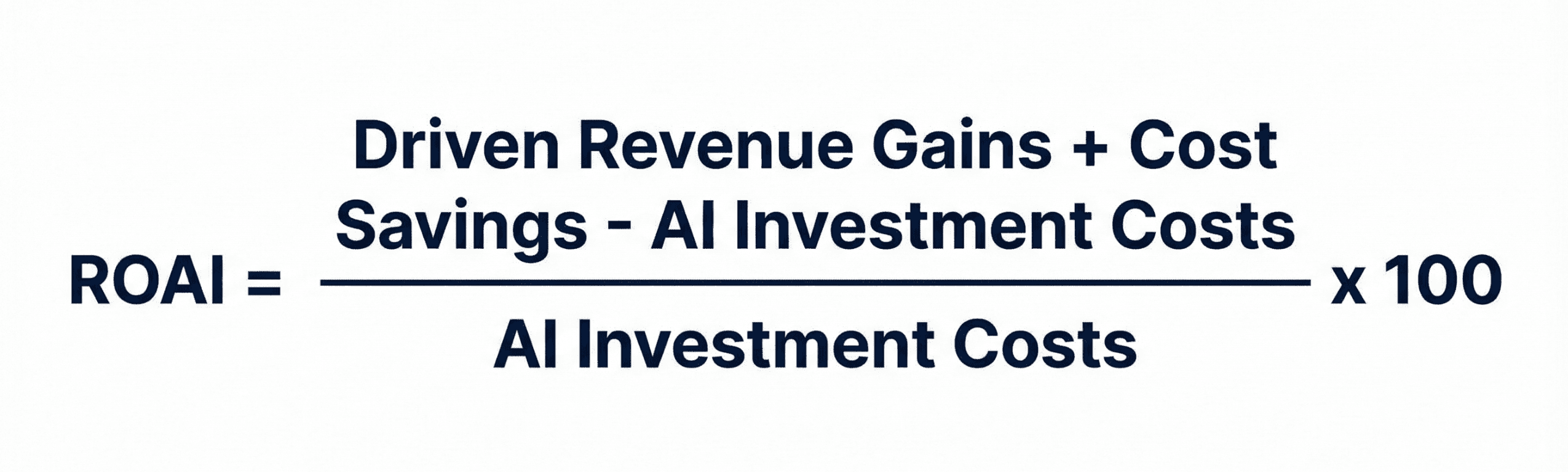
The potential for return is significant. UAE Benchmark data indicates that leading enterprises in Dubai and Abu Dhabi report an average ROAI of 250–400% within 18 months when following structured implementation frameworks. This high return is possible because, unlike static software, AI evolves to create new value streams.
How AI Drives Business Growth
To achieve the ROAI targets mentioned above, it is essential to distinguish true AI from standard software. AI solutions utilize real-time data and advanced algorithms to optimize decision-making, accelerate workflows, and elevate customer service. This differs fundamentally from traditional automation, where systems operate on fixed rules and pre-programmed instructions. While automation is effective for repetitive tasks such as data entry, report generation, or scheduling emails, it follows a static pattern and lacks the capability to adapt or learn on its own.
In contrast, Artificial Intelligence evolves.
It learns from dynamic data sets and improves performance over time. This capability allows the system to identify complex patterns, interpret context, and predict future trends. Beyond simple execution, AI goes beyond the basics to conduct research, resolve customer queries, plan inventory, and drive marketing campaigns. Ultimately, this adaptability and panoramic approach provide businesses with the agility required to compete and grow in a fast-paced, evolving market.
Strategic Growth Drivers of AI Investment
As AI gains traction across sectors, the conversation has shifted from "efficiency" to "value creation." While traditional ROI looks at cost reduction, the true drivers for AI adoption in 2026 focus on competitive differentiation and revenue capability.
Below are some of the influential factors suggesting you adopt AI in your business:
Agentic Workflows:
AI has evolved into "Agentic Workflows," where systems don't just follow rules—they autonomously plan, execute, and course-correct complex tasks. Apart from just creating AI reports, these AI agents can analyze sales data, identify everything related to a region, and draft any marketing strategy for approval. Isn’t it a massive lift?
Predictive Revenue Intelligence:
AI now moves beyond simple “data-driven decision making” and powers Revenue Intelligence. AI models integrated into CRM platforms (like Salesforce or Odoo)
It lays down a task wherein it understands the historical deal cycles to know the previous pattern of responses, flag at-risk accounts before they churn, and suggest the "next best action" to close deals faster.
Hyper-Personalization at Scale:
Customer experience is no longer about "segmentation"; it is about individualization. Instead of sending one newsletter to 10,000 people, AI can instantly generate 10,000 unique versions of any marketing collateral based on recipient's past behaviour, industry constraints, and predicted needs. Thus, personalized touch and direct connection with each potential customer.
Regulatory Agility & Risk Mitigation:
For markets with complex compliance landscapes such as the UAE’s evolving e-invoicing mandates, AI is working as a critical shield. How? Adaptive AI systems can monitor regulatory changes in real-time (e.g., updates to Peppol or PINT standards) and automatically flag non-compliant transactions before they are processed. Thus, a compliance can also turn into a risk-free competitive advantage.
ROAI in Action: UAE Digital Commerce Leaders
AI is no longer a buzzword; it's the silent engine behind industry transformations. From improving healthcare decisions to streamlining legal processes and boosting factory efficiency, businesses across sectors are deploying AI not just to automate, but to innovate.
In this section, we spotlight how forward-thinking companies like RedSea, JPMorgan Chase, Siemens, and King’s College Hospital London have successfully implemented AI solutions to solve complex challenges, deliver measurable outcomes, and lead the way into a brighter future.
1. Red Sea Global — AI in Sustainable Tourism
(The Smart Destination Benchmark)
Challenge: Developing a regenerative tourism destination the size of Belgium (28,000 sq km) required managing massive environmental data and delivering hyper-personalized guest experiences without damaging the ecosystem.
Solution: Red Sea Global deployed an AI-driven Smart Destination Platform and a network of over 2,500 IoT sensors. These systems monitor environmental metrics such as lagoon health and coral reef vitality in real-time while unifying data to personalize guest journeys before arrival.
Impact:
Data Unification: Consolidated disparate data environments into a 360-degree operational view, enabling "Agentic" decision-making for resource management.
Sustainability: AI optimizes energy use across the destination to meet Net Zero goals, ensuring the "regenerative" promise is met while reducing operational waste.
2. King’s College Hospital London (Dubai) — AI in Healthcare Operations
(Velocity in Patient Care)
Challenge: High administrative loads and the need for precision diagnostics often slow down patient care cycles, a critical metric in healthcare "velocity."
Solution: The Dubai facility implemented Ambient Clinical Voice, an AI solution that passively listens to doctor-patient interactions to automatically generate accurate medical notes. They also integrated AI-powered diagnostic tools for radiology.
Impact:
Operational Velocity: Achieved a 50% reduction in time taken to access patient information and a 25% reduction in overall time spent on Electronic Health Records (EHR).
Quality & Accuracy: Enhanced diagnostic precision in radiology, flagging potential issues (like early-stage breast cancer) faster than manual review.
3. JPMorgan Chase — AI in Finance
(Global Benchmark for Document Intelligence)
Challenge: Manual review of legal contract documents consumed enormous time and left room for errors. Plus, AI-driven detection of fraudulent transactions remained elusive.
Solution: The bank’s Contract Intelligence (Coin) platform uses AI-powered document parsing to extract critical data, combined with anomaly detection systems to flag suspicious behaviour.
Impact:
Legal document review dropped from 360,000 human hours per year to seconds
Sharp reduction in fraud losses through earlier and more accurate detection
4. Siemens — AI in Manufacturing
Challenge: Equipment downtime and inefficiencies in production lines threatened profitability and output reliability.
Solution: Siemens integrated predictive maintenance AI and process-optimization models into its factories. Machine learning models predict failures before they occur and flag inefficient processes.
Impact:
Up to 50% reduction in unplanned downtime
20% increase in production efficiency
These stories don’t just showcase technology; they also demonstrate impact. The next and most crucial step is to select an AI solution provider for your business.
Selecting the right AI Solution for Business
Choosing the right AI solution for business isn’t just about jumping on the trend, it’s about finding the perfect fit for your unique goals, lineup, and return on AI investment. Here’s a practical roadmap to guide your decision-making:
1. Start with Clear Business Objectives
Define what you want AI to achieve such as:
Automate repetitive tasks like data entry or ticket triage
Enhance customer experiences via chatbots or sentiment analysis
Drive strategic decision-making through predictive analytics edX emphasises aligning AI with specific needs: “automate tasks, enhance customer service, or improve decision making”.
2. Choose the Right Type of AI
Not all “AI solutions” for business are built the same way. The tech giant, Microsoft identifies three tiers to match your goals:
Assistants (e.g., Microsoft 365 Copilot) for productivity boosts
Prebuilt, extendable solutions for mid-tier customization
Custom AI/Agents for fully-tailored enterprise-grade systems
3. Evaluate Technical Fit & Scalability
It must integrate seamlessly with your CRM, ERP, or existing apps.
Look for intuitive low-code tools and other AI “skills” to speed up development and adoption.
Platforms should support end-to-end agent workflows that grow with your business.
4. Prioritize Security, Compliance & Governance
For enterprises, robust governance is non-negotiable:
Choose systems with audit trails, access controls, and clear human-in-the-loop approvals.
Ensure data privacy and ethical AI practices, reducing bias and meeting regulatory standards.
5. Consider Vendor Trust & Support
Prefer vendors with experience in your industry.
Support with training, troubleshooting, and platform updates is essential.
6. Analyze Cost vs. ROI
The cost includes licensing, customization, training, and maintenance.
Consider realistic gains, such as productivity improvements, cost savings, or revenue lift.
7. Pilot, Learn & Iterate
Deploying an AI assistant or agent for a single workflow works well in most cases.
Use real metrics (time saved, error reduction, satisfaction) to refine before scaling.
Therefore, once you have AI solutions for business to help streamline your operations, it can coordinate the tasks, automate workflows, and support business operations.
Remember: AI isn’t an afterthought; it is built into every layer of the platform. Make sure to walk forward with the right intention and value in mind.
Conclusion: Architecting Growth for High ROAI
AI is no longer a futuristic concept; it is the silent engine defining the next era of business resilience. As demonstrated by leaders like Red Sea Global and JPMorgan, the difference between "using" AI and "winning" with AI lies in the shift from generic adoption of automation to measurable Return on AI (ROAI).
True transformation requires more than just installing tools; it demands a strategic architecture where AI is embedded into the very fabric of your workflows. To achieve the velocity and quality improvements that drive 100%+ ROAI, businesses must deploy purpose-built solutions that solve specific friction points.
This means evolving from manual content efforts to autonomous, authority-building engines (metamenu) and replacing slow quality assurance cycles with accelerated, no-code test automation (Sedstart). It involves reimagining customer engagement through hyper-realistic visual experiences (fitchek) and empowering teams with instant, context-aware knowledge retrieval (Vidura). To better understand them better, you’re just a click away.
Ready to define your ROAI?
Already more than 50% of enterprises are on track of strategic AI adoption and over 65% of organisations in the Middle East plan to increase investment in AI in the 2027.
Adopting AI is easy; making it profitable can be challenging. Stop guessing where to start. Book a 30-Minute AI Readiness Call with our solution architects today.
In this session, we will:
Assess if your current infrastructure is ready to support high-ROAI solutions.
Pinpoint all the operational bottlenecks from QA to content that offer the fastest path to value.
Create a clear, metric-driven roadmap for implementing AI solutions that scales.